


Active Rehabilitation Camp
A comprehensive programme for people with spinal cord injury that strengthens their independence, mobility, and social participation through the internationally recognised peer-to-peer approach and knowledge exchange with rehabilitation professionals.
Problem
Due to the full-scale war, the number of people with spinal cord injury (SCI) in Ukraine has risen sharply. After discharge from medical rehabilitation, many struggle to regain independence, mobility, and social participation.
Goal
To strengthen the independence, mobility, and community participation of people with SCI through Active Rehabilitation Camps based on the peer-to-peer approach and knowledge exchange with rehabilitation professionals.
Key objectives
- motivate people with SCI to seek new meaning in life through the living example of leaders with similar injuries;
- improve participants’ practical skills in wheelchair use and independent living;
- increase self-confidence, self-efficacy, and readiness for active community participation;
- strengthen peer-support networks among people with SCI;
- enhance the capacity of rehabilitation professionals to apply Active Rehabilitation principles.
Format & frequency
Each year the programme runs 2 major Active Rehabilitation Camps and 1–3 smaller recreational camps. Each camp hosts 12–18 participants, depending on the level and complexity of injury.
Beneficiaries
All beneficiaries are people with disabilities (spinal cord injury); each camp involves 12–18 participants depending on the level and complexity of injury. Rehabilitation professionals, rehabilitation centres, and organisations adopting Active Rehabilitation practices benefit indirectly.
Activities
- Active Rehabilitation Camps;
- peer-to-peer mentoring;
- training in independent-living and wheelchair skills;
- adaptive sports and physical activity;
- capacity building for rehabilitation professionals.
Expected results
- improved independence and mobility of participants with SCI;
- increased confidence and self-efficacy;
- enhanced competencies of rehabilitation professionals;
- wider application of the Active Rehabilitation methodology in Ukraine.
The programme has been supported by various partners over time. Among the most recent are the World Health Organization (WHO), Prytula Foundation USA, and the «League of the Strong» NGO.
People with spinal cord injury gain practical skills and the confidence to lead independent, active lives, while professionals strengthen their capacity to deliver person-centred services. The project contributes to a more inclusive and effective rehabilitation system in Ukraine.
Leaders of Accessibility
Training people with spinal cord injury for advocacy and engaging them in community Resilience Centres across the Ternopil, Volyn, and Rivne oblasts on a peer-to-peer basis.
Problem
People with spinal cord injury in small communities of western Ukraine are systematically excluded from decisions on recovery and accessibility. There is a shortage of trained civic advocates from among persons with disabilities, of sustainable mechanisms for their engagement, and of paid roles. Resilience Centres rarely plan activities involving people with disabilities.
Goal
To strengthen the leadership, civic participation, and resilience of people with SCI in the Ternopil, Volyn, Rivne, and Khmelnytskyi oblasts by training them as civic advocates for accessibility and inclusion and integrating them into local Resilience Centres on a peer-to-peer basis.
Objectives
- train 25–30 people with SCI as civic accessibility advocates through an online school;
- select and support 10–12 of the best as paid advocates in Resilience Centres;
- conduct ≥15 accessibility audits and appeals to local self-government bodies;
- organise ≥18 joint inclusive activities for people with disabilities and community residents.
Target audience
Local self-government bodies, community Resilience Centres, residents of small towns in the Ternopil, Volyn, Khmelnytskyi, and Rivne oblasts, IDPs, veterans, and their families and close circle.
Beneficiaries
Direct: 25–30 people with SCI (prioritising women with SCI and IDPs), of whom 10–12 become paid advocates; mentors. Indirect: visitors of Resilience Centres (IDPs, veterans, local residents), local self-government bodies, and the wider communities of four oblasts.
Activities
- selection and onboarding of participants in 3 oblasts (September 2026);
- online advocacy school — 3 modules (September–November 2026);
- competitive selection and employment of 10–12 advocates (November–December 2026);
- advocacy work in Resilience Centres: audits, appeals to LSGs (December 2026 – February 2027);
- joint inclusive activities — ≥18 sessions;
- mentoring support and coordination of the advocates’ network;
- final conference, recommendations for LSGs, and dissemination of the model.
Results
10–12 people with SCI become active civic advocates in their communities and continue cooperating with Resilience Centres after the project ends. Local authorities receive concrete accessibility recommendations. A regional network of accessibility advocates is formed. A scalable ‘training → employment → participation’ model is piloted.
The project fosters the inclusion of people with spinal cord injury in community recovery, reduces their social isolation, and builds a culture of inclusive governance at the local level.
«First Contact» Programme
Supporting people with spinal cord injury during treatment and rehabilitation through peer instructors with their own lived experience of life after injury — to prevent complications, speed up adaptation, and enable a return to active life in the community.
Problem
Due to the war, the number of people with spinal cord injury (SCI) in Ukraine has risen sharply, while the rehabilitation system suffers from a shortage of specialists. A gap opens between discharge from a medical facility and support in the community. In 2025 alone, over 170 new people with SCI were identified (database — 600+). Insufficient quality rehabilitation leads to complications and hinders a return to a full life.
Goal
To provide comprehensive support to people with SCI during treatment and rehabilitation through peer instructors, prevent complications, raise awareness, and foster adaptation and a return to active community life.
Objectives
- identify patients with SCI in medical and rehabilitation facilities and add them to the support database;
- prevent complications (pressure sores, selection of assistive devices, bladder and bowel management) and support adaptation;
- raise awareness among patients and medical staff about SCI consequences and recovery methods;
- support people with SCI and their families in communities according to an individual plan;
- inform local authorities about inclusion, accessibility, and correct terminology.
Beneficiaries
Direct: people with SCI during treatment/rehabilitation and after returning to the community, as well as their families. Indirect: medical workers, local authorities, and wider communities. Support is provided by peer instructors across eight regions of Ukraine.
Activities
- peer instructors working with patients in medical and rehabilitation facilities;
- motivational meetings, demonstration of independent-living skills, and experience sharing;
- individual support for people with SCI and their families in communities;
- regular awareness and educational events in communities;
- training and lectures for representatives of local authorities;
- weekly and monthly monitoring, coordination, and reporting.
Results
Over 170 people with SCI receive first contact and ongoing support each year, expanding the database (600+). Complications are prevented, adaptation accelerates, and awareness among medical staff and authorities grows. Participants join GAR’s other programmes and may later become instructors themselves.
Permanent partners are the World Health Organization (WHO) office in Ukraine and Choose Love. GAR is a co-founder of the «League of the Strong» NGO. It also cooperates with the Barrier-Free initiative, the Patients of Ukraine Foundation, and professional associations of physical rehabilitation specialists.
The programme fills the gap between medical rehabilitation and community life and builds a sustainable peer-to-peer support model that fosters inclusion and people’s return to active life. The model scales easily to other regions — preceded by the preliminary identification of people with SCI and the training of local instructors.
Active Rehabilitation in the Community
A comprehensive active-rehabilitation programme for people with spinal cord injury: systemic activation in communities, sustainable dialogue with local authorities, and advocacy for the legal recognition of the peer-to-peer service.
Problem
After returning home, people with SCI fall outside systemic services and face barriers — physical (inaccessible housing, underdeveloped barrier-free environments), institutional (their needs are not reflected in local programmes), and informational. The peer-to-peer service still has no official definition in Ukraine, which hampers scaling and state funding. The war is increasing the share of veterans and civilians with SCI.
Goal
To strengthen the capacity of people with SCI — both previously and newly identified — to participate fully in community life through local-level activation, sustainable dialogue with LSGs and service providers, and advancing the legal definition of the peer-to-peer service nationally.
Objectives
- systemic activation of beneficiaries across 7 regions through in-person and remote support and group work;
- identification of critical participation barriers and creation of regional “barrier maps”;
- establish a “service recipient — service provider” dialogue with LSGs and social and medical services through joint trainings, working meetings, and other activities;
- two active rehabilitation camps (Rivne, Ternopil) with veteran participation;
- advocacy for defining the peer-to-peer service and GAR’s organisational development.
Beneficiaries
Direct: people with SCI in the Dnipropetrovsk, Volyn, Vinnytsia, Ternopil, Rivne, Kyiv, and Lviv oblasts (including veterans and civilians injured during hostilities) and their families. Indirect: representatives of LSGs, social and medical services, rehabilitation specialists, students, employers, and the wider public across seven regions.
Activities
- in-person and remote support for beneficiaries (new Remote Counselling Service, CRM);
- joint trainings and working meetings with LSGs; “barrier maps” and cooperation roadmaps;
- two active rehabilitation camps (Rivne — August; Ternopil — September 2026);
- housing adaptation, legal support, and advocacy for the peer-to-peer service;
- training of specialists and students; communication campaign (reach 400,000+).
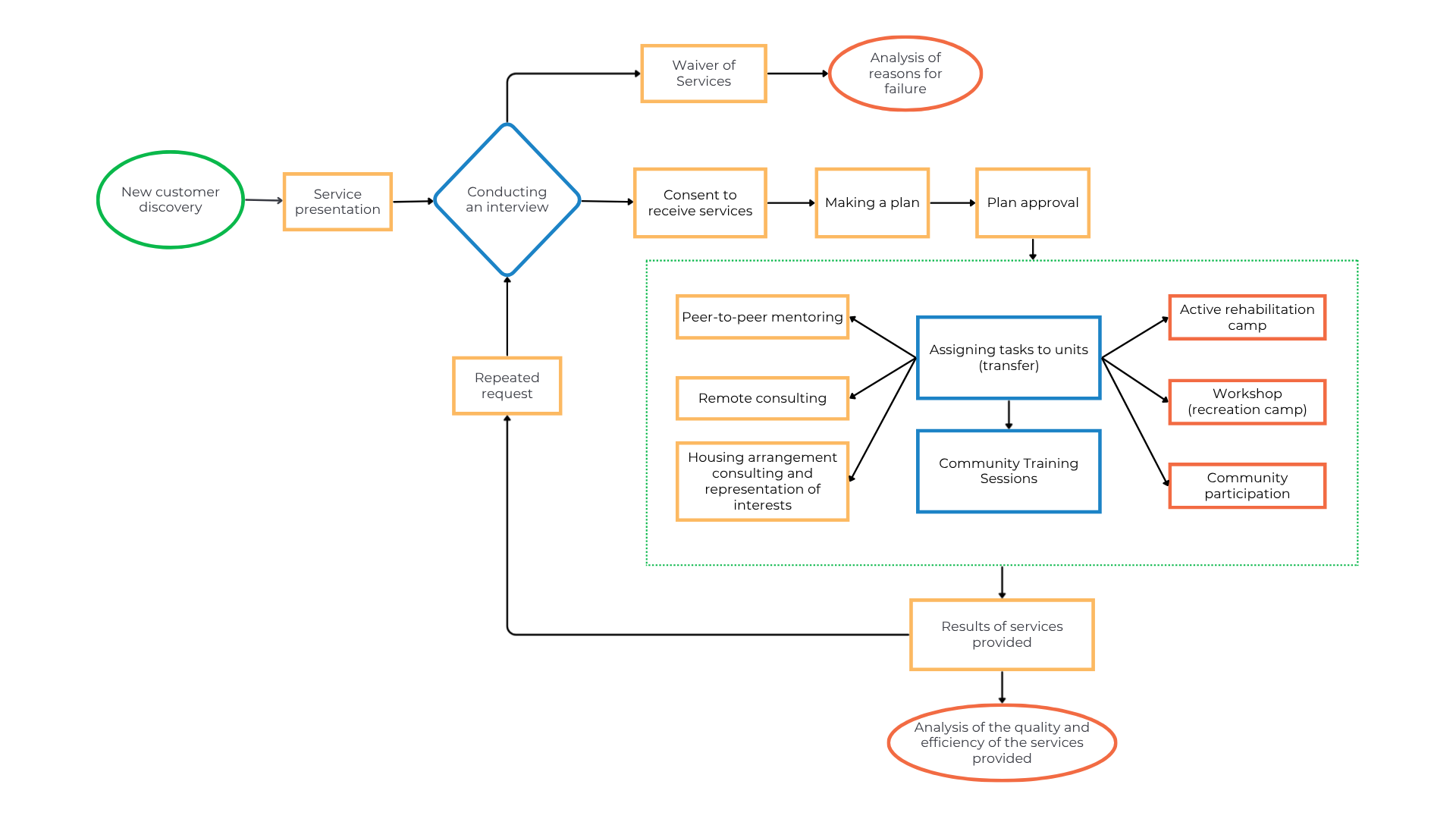
Client journey at the community level
Visualized roadmap for working with a client after spinal cord injury at the community level.
WHO office in Ukraine, the Ministry of Health and the Ministry of Social Policy, the Presidential Commissioner for a Barrier-Free Environment, universities (Bobersky University, DSMU), Sunnaas Rehabilitation Hospital (Norway), business (Nestlé), and organisations of persons with disabilities.
The programme establishes a sustainable model of community-based active rehabilitation in which the needs of people with SCI are reflected in local accessibility policies, and the peer-to-peer service gains legal recognition and state funding — making support accessible and scalable across Ukraine.
Active Rehabilitation for Children
Ukraine’s first active-rehabilitation programme for children and adolescents with spinal cord injury, based on the experience of Poland’s Fundacja Aktywnej Rehabilitacji (FAR): training a Ukrainian team, identifying and engaging families, and running camps and activities for children and parents on a peer-to-peer basis.
Problem
Ukraine has no active-rehabilitation programme aimed at children and adolescents with spinal cord injury (SCI). The war is increasing the number of such children, yet families remain without systemic support, independence skills, or a supportive environment. Children face isolation early, while parents lack knowledge about care, mobility, and developing their child’s independence.
Goal
To create Ukraine’s first active-rehabilitation programme for children and adolescents with SCI by adapting the proven model of Poland’s Fundacja Aktywnej Rehabilitacji (FAR): training a Ukrainian team of instructors, identifying and preparing families, and running camps and activities on a peer-to-peer basis. GAR has over 20 years of experience running active-rehabilitation camps for adults and is deliberately preparing for the specifics of working with children — including developing the necessary policies.
Objectives
- train a Ukrainian team of instructors in the FAR methodology (with Polish colleagues);
- identify families with children with SCI and prepare them to participate (in person and online);
- run pilot active-rehabilitation camps and workshops for children and parents;
- develop a Ukrainian-language methodology and materials and run a broad communication campaign;
- develop the necessary policies (child protection, safety) and prepare the team and organisation for working with children.
Beneficiaries
Direct: children and adolescents aged 4–16 with SCI who use a wheelchair, and their parents and guardians. Indirect: trained Ukrainian active-rehabilitation instructors, rehabilitation specialists, wider communities, and future participants of the programme across Ukraine.
Components
- experience transfer and training of the Ukrainian team by FAR specialists (Poland);
- family identification and individual support (in person and online ZOOM sessions);
- workshops (children 4–6 with parents) and a camp (children 7–16) of active rehabilitation;
- parent trainings: care, mobility, self-care, psychology, rights;
- development of methodology and learning materials + a broad communication campaign.
Fundacja Aktywnej Rehabilitacji (FAR, Poland) — the methodology holder and team-training partner. Engagement of UNICEF, the Ministry of Social Policy and the Ministry of Health, local communities, and organisations of persons with disabilities.
The project establishes in Ukraine a sustainable model of active rehabilitation for children with SCI: children gain independence earlier, families receive support, and the trained team and Ukrainian-language methodology make it possible to scale the programme across the country.
Organisational Development and Service Scaling
Strengthening GAR’s institutional capacity to sustain and scale its proven directions — remote counselling and accessibility — and to roll out a structured training offer for diverse audiences. The directions can operate independently or as components of other projects.
Problem
GAR’s proven directions — remote counselling and accessibility — are in steady demand, yet their sustainability is constrained by staffing instability and dependence on project funding. The organisation’s training expertise is sought by diverse audiences (LSGs, business, universities, schools) but is not structured into a systematic offer, and its institutional capacity needs strengthening to scale.
Goal
To strengthen GAR’s institutional capacity so as to make its key directions — remote counselling and accessibility — sustainable and scalable, and to roll out a structured training offer for diverse target audiences. The directions can operate both independently and as components of other projects.
Objectives
- strengthen the organisation’s structure, HR, M&E, CRM, and fundraising;
- ensure the sustainability of the remote counselling and support direction;
- develop accessibility and housing adaptation as a standalone service;
- structure the training offer for LSGs, students, educators, business, and communities;
- introduce systematic onboarding, identification, and preparation of leaders — active members of the organisation and representatives of their communities.
Directions
- remote counselling and support for people with SCI (736 consultations, 960 hours in 2025);
- accessibility: housing adaptation, audits of communities and infrastructure (public service centres, routes; EGAP, UNDP);
- leadership and network: systematic onboarding, identification, and preparation of leaders — active representatives of their communities;
- organisational development: CRM, M&E, HR, and fundraising.
Trainings for audiences
A structured offer for: local self-government bodies and their representatives; students of various specialities (including Bobersky University); educators, schools, and carers, and work with children and pupils; business, utility, and transport services (such as Kyivpastrans — 1,435 drivers); rehabilitation specialists. In 2025 — 136 trainings for over 1,600 participants.
The Ministry of Digital Transformation (EGAP), UNDP, the National Academy of Internal Affairs, Lviv Habilitation Center, the Alliance for Public Health, the Patients of Ukraine Foundation, Bobersky University, Kyivpastrans, and local self-government bodies.
The project makes GAR’s key services sustainable and scalable and its training expertise systematic. A stronger organisation and trained leaders — active representatives of their communities — ensure quality support for people with SCI and the development of accessibility across Ukraine, both independently and as part of other projects.
No projects match your search.
Public reporting
Financial and programme reports of the Group for Active Rehabilitation.