

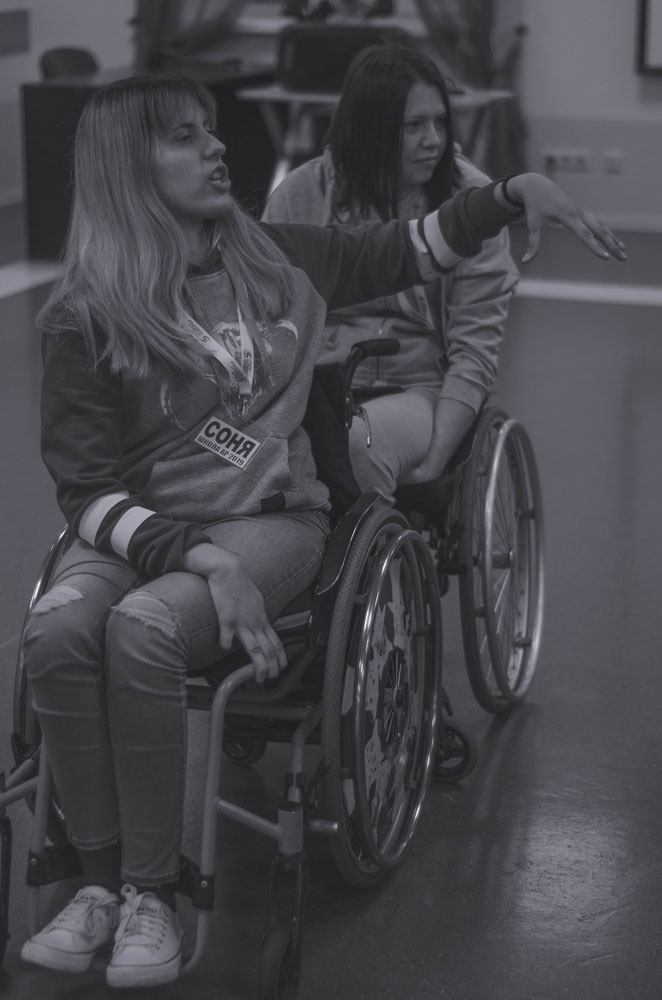
She acquired her disability at the age of nine as a result of a stroke.

Sofiia, please tell us your story.
After the injury I spent a very long time in intensive care and in hospitals, so I did not really understand what had happened. I did not even realise that I could not feel my legs. I lay there wondering why I was taking so long to get up, and how I would get home. I do not remember anyone talking to me about disability or about the fact that I would not walk. Somehow I took that information as a matter of course. My parents supported me, and I even made friends. At school, for some reason, I had no circle of my own, but after the injury I moved to home schooling and we started talking with my classmates. I do not know what was going on at school, but everyone treated me well.
A child probably perceives such a condition differently from an adult. How did your attitude to disability change as you grew up?
I was an active child: garages, trees, fences, scraped knees — so I had no wish to see the places where I used to run. It hurt to realise I could not do that any more. I know it was hard for my parents to take it all in: in hospital I think I had more than one stroke, my lungs were failing, the doctors made a real mess of something. So my parents looked after me for a long time, and I truly needed it. It is only recently that I have started living an active social life. Right now I am interning at a bank, running their social media and writing for the website. Yes, I need the money, but I also enjoy writing. On top of that I study at the Kyiv Gestalt University. I already have a degree in psychology, but I am continuing my studies in the field that attracts me most right now.

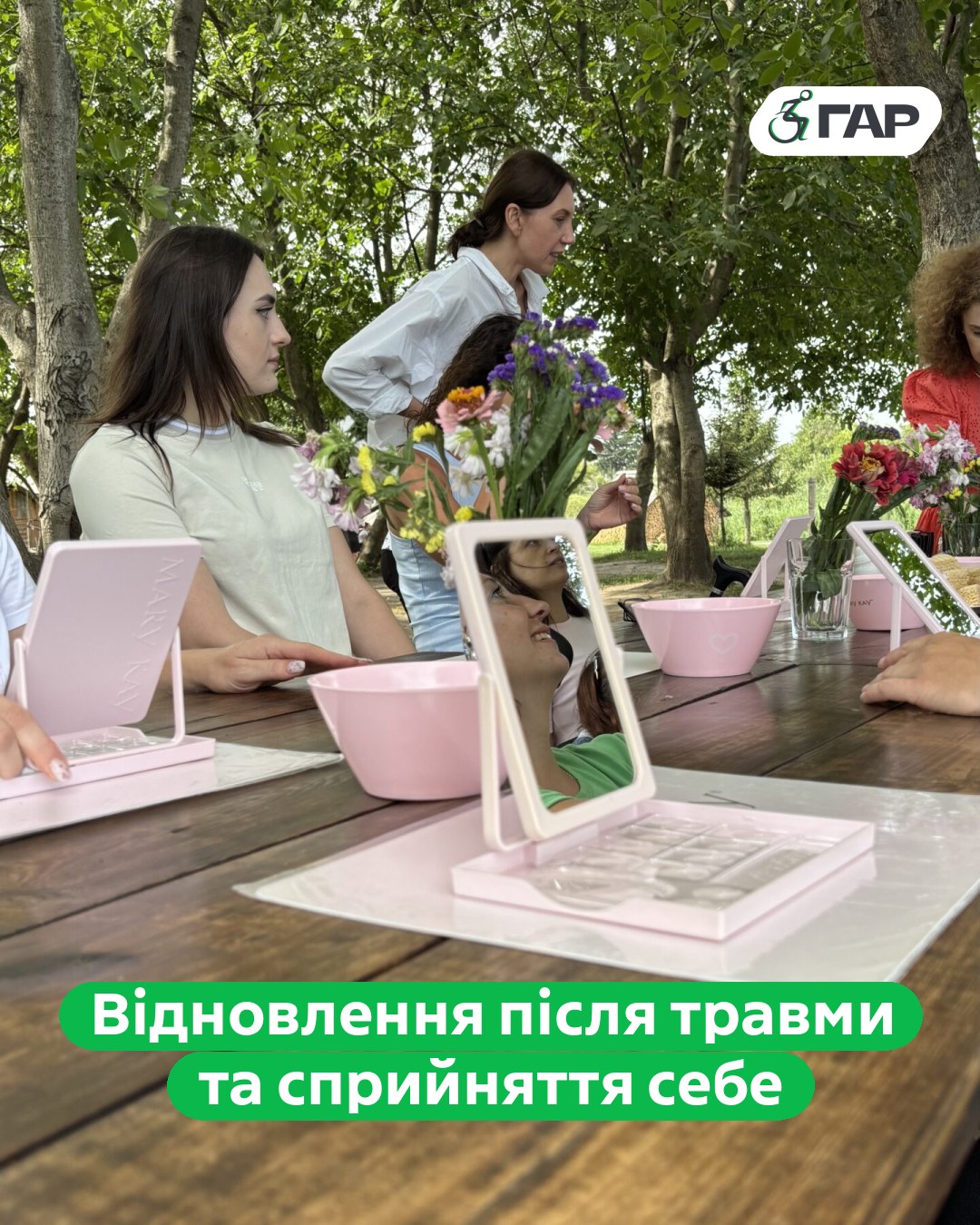
What are your impressions of the active rehabilitation school for girls?
You know, today I realised that I am enjoying myself here the way I did long ago, at my first camp, where I met Uliana. The trainers, volunteers, lecturers and participants here are wonderful. I love them all. We have a great atmosphere; I see how persistent the girls are and it inspires me, it keeps me from stopping or giving up. I try to help others too, to give advice. The way people talk to each other at the camp is very healthy and comfortable.
So you plan to keep developing in psychology.
Yes, psychology is a field where you have to study a great deal to have enough experience of your own to help others. For now I cannot allow myself to counsel people regularly, because I do not want to do harm. Above all I have to be honest with myself.
What do you think society should pay attention to?
First of all, we are all people. There is no need for demeaning terms like «invalid» or «person with limited abilities». Some people ride a scooter, some drive a car, some walk on their feet, and I move on wheels. That is normal. It is not my problem that I cannot get into some venue — it is that venue’s problem. Conditions have to be created. Like anyone else, I want to spend my money, buy something, spend time with friends. But a map appears in my head straight away and I start assessing the area, working out where I will be able to get in. I want people to see that I am not sitting by the metro or on a square begging. I am an ordinary person with my own needs and interests, and my wheelchair does not limit me.