

The National Assembly of People with Disabilities of Ukraine, together with UCP Wheels for Humanity (USA) and the Ukrainian Association of Physical Therapists, with financial support from the United States Agency for International Development (USAID), is implementing the international project «Training, economic empowerment, assistive technology and medical/physical rehabilitation services» in Ukraine.

The project provides for six active rehabilitation camps as one of the methods of restoring a person’s physical and social condition after a complex spinal injury with damage to the spinal cord (Rekryteringsgruppen).
The partner in organising the camps is the Ukrainian Association of Persons with Disabilities «Group for Active Rehabilitation».
The goal of the camp is for a person who uses a wheelchair to reach the greatest possible independence from outside help, and so to improve their quality of life.
The philosophy of the camp rests on the motto: «once you have learned to live in a wheelchair yourself, teach someone else».

The first camp took place at the Western Rehabilitation and Sports Centre from 2 to 13 February 2016, with 20 people with spinal injuries from 14 regions of Ukraine. This time the participants were split almost evenly: at earlier camps the group had almost always been mostly men, and now there were eight women, which only spurred the other twelve men on to work well.
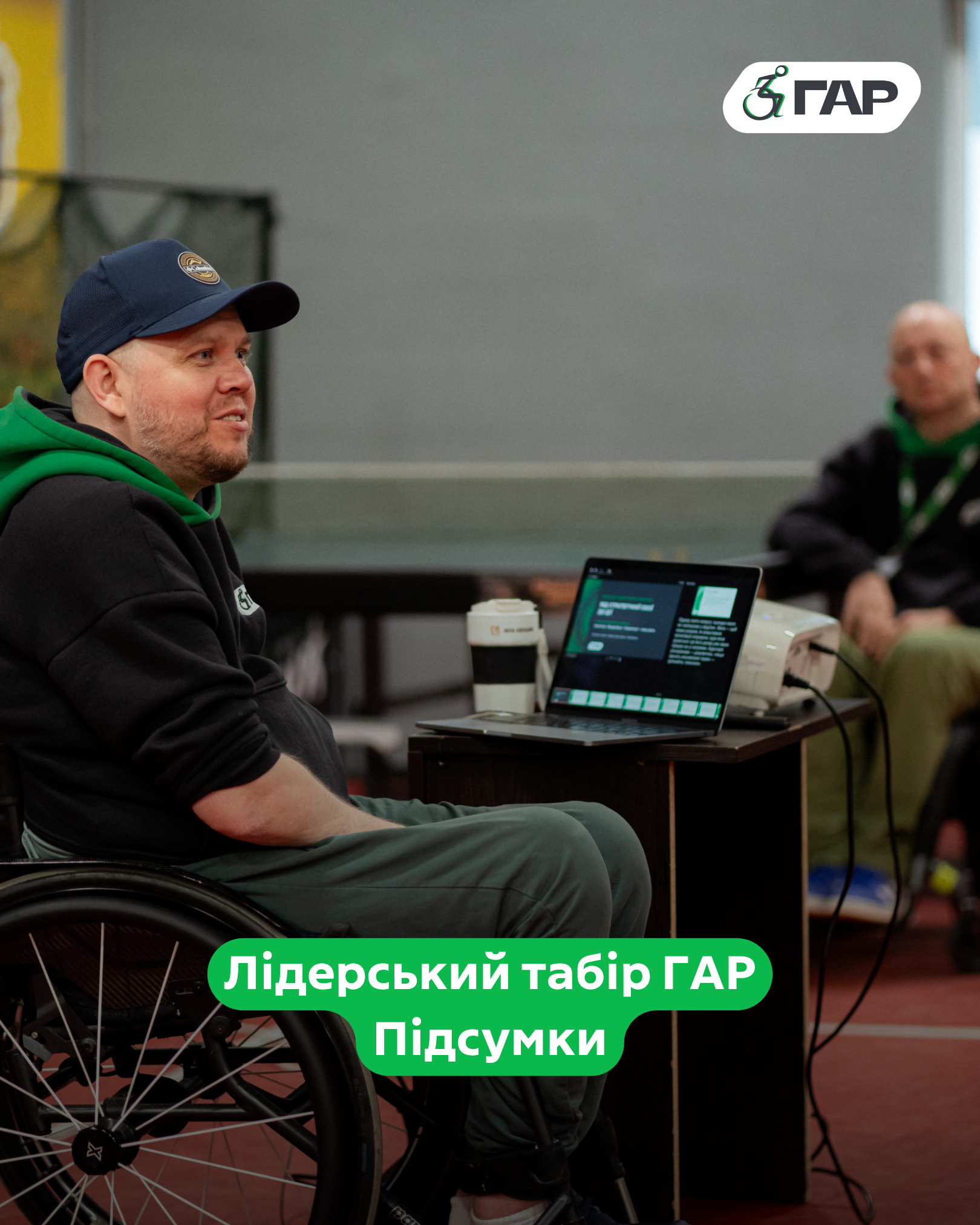
As is now the tradition, participants could master four disciplines: wheelchair skills, general physical training, aerobics and table tennis. The first two are an inseparable part of life for anyone who uses a wheelchair: the first gives you command of an active-type wheelchair and readiness for any obstacle in our unadapted cities; the second lets people learn how to build a proper training routine at home, so that they come to understand the importance of the right load on the muscles and, above all, what not to do in order to avoid harm. As for aerobics, it is always fascinating for us as organisers to watch participants arrive deeply sceptical about its usefulness — and, having completed the full cycle of sessions, state almost unanimously that it is not only great fun but physically demanding, and that they will certainly keep practising at home. Table tennis is inspiring as always, and many said they would like to take it up at home, since it is one of the least demanding Paralympic sports.

For perhaps the first time, the organisers were able to run every discipline without a shortage of equipment: all the necessary gear was bought through the international project in Ukraine. Every instructor noted how much this mattered — they could concentrate on the participants instead of improvising equipment.
The time free of training was no less full: twelve lectures and discussions were held on subjects that directly concern the quality of life of people who use wheelchairs, along with two highly emotional events — the organisational game and «mayhem», where participants could show their creativity and their skill at solving everyday problems: cleaning, washing the floor, ironing, cooking, making a bed and so on.
At the end we planned to try winter sports, namely riding specialised bobs, but the weather had a view of its own and gave us very heavy precipitation — in the form of rain. As a result we could not try ourselves on the snow, but it gave the whole camp the chance to look closely at how to care for a wheelchair properly, why it matters, and — most importantly — to practise it.
The time passed quickly, and the last party was a warm one, because besides new skills many had found new friends. No camp is easy, but each brings a very good result: real change in the lives of everyone who takes part, which they feel as soon as they reach the railway station. One will take up sport, another will find work or start studying, someone will come back to us as a trainee — and for someone nothing will change, and that is normal too. But in every single person a spark of active rehabilitation is lit, and it will not leave them as they were. And that is what gives us the drive to keep working.

During the camp we were visited by the project coordinator in Ukraine, Oleksandra Kalandiak, with her colleagues Viktoriia Nazarenko and Yurii Metko. They spoke about the project in Ukraine and about how people with disabilities can take part in it. We agreed to hold seminars for doctors and physical therapists alongside future camps.
We thank all our partners for the chance to run the camps at a higher standard — it matters a great deal and has a positive effect on the quality of our work and therefore on the service we provide to our participants.
The next camp will take place from 2 to 13 April 2016. Everyone interested is welcome to apply!